Your Ad Here
Showing posts with label Shipping. Show all posts

Sunday, February 20, 2011

Diana Shipping Shines Despite Shipping's Foggy Future

Diana Shipping (DSXdsx quote is in the business of dry bulk shipping. Diana ships dry bulk goods such as wheat, iron ore, coal, and other commodities. In the recent past, the dry bulk shipping industry has been beaten down. While the future of the dry bulk industry is hard to predict, Diana is positioned to do very well in the event that dry bulk shipping picks up again and I believe it can withstand a sluggish future in shipping.

Industry overview 


The dry bulk shipping industry is driven by a variety of factors. The main factors (in order of importance) are:

1. Commodity Demand
2. Fleet Supply
3. Fuel prices
4. Weather

The volatility of these factors makes the dry bulk shipping a cyclical industry. The factors listed above led to a boom in 2007/2008. China's seemingly insatiable demand for dry bulk goods, particularly iron ore was the main driving factor. From late 2006 to late 2007, Diana's stock price returned 300%. However, as it turns out, China's demand was eventually satisfied and the industry went bust late in 2008. Subsequently, Diana's stock price fell about 60%.

The last couple years have been sluggish for shipping. What's worse is that shipping isn't out of the woods yet. There are more worries for the future of dry bulk shipping. This article from Morningstar gives a good overview of the industry. One would think that an industry whose forecast is fraught with fears would be an unattractive investment. I would argue otherwise. To quote Buffett, "Be fearful when others are greedy, greedy when others are fearful". The fear surrounding the shipping industry presents a great opportunity for investment.

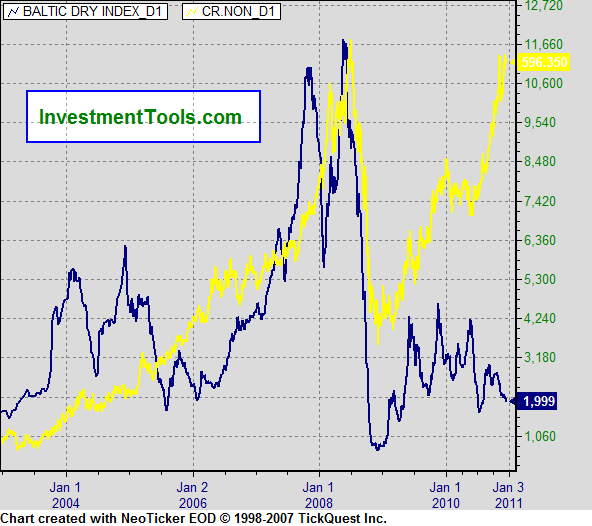
As mentioned above, commodity prices have a large impact on the shipping industry. Below is a graph plotting the BDI (A measure of shipping prices) against the CRB index (a measure of commodity prices):
[click to enlarge]


From 2002-2009 there was a modest relationship between commodity prices and shipping rates. The rationale behind the relationship is as follows: As demand for commodities increases, the price increases. The buyers and sellers of the commodities need to transport the commodities to each other, thus demand for shipping increases subsequently raising shipping rates.

Starting in 2010, the relationship ceased to exist. Commodities and shipping started moving in opposite directions. A couple of reasons that prices may be staying low is because of an increasing supply of vessels, and the increasing price of crude oil. However, the high oil prices in 2007/08 didn't seem to slow down shipping rates. That being said, the only factor contributing to low shipping rates is the oversupply of vessels. I think this factor is overplayed. While vessel supply is expected to grow in the 10-12% range from 2009-2011, vessel scrapping is also on the rise. This will partially offset the increased supply in vessels. All things considered, I believe today's shipping prices are artificially low. Increasing commodity demand should increase shipping, leading to an increase in shipping rates.

Company overview

When people think bulk dry shipping, they think of shipping iron ore and coal. This is a major part of the industry, but does not contribute as much to Diana's bottom line as it does to its competitors. Based on Diana's fleet composition and major customers, it would appear that Diana is mainly focused on the supply of grain and wheat. Diana's fleet is comprised primarily of medium sized vessels. Medium and small sized vessels are used for shipping mainly iron ore, coal, and grains. A benefit of smaller ships is that they are the more economically efficient for transporting grains. The downside of medium-sized vessels (as compared to larger vessels) is that they don't benefit from the same economies of scale from transporting iron ore. Over the past few years, Diana's largest customers have been Cargill, BHP (BHP), The Australian Wheat board, and China National. These customers have represented approximately 35-50% of revenues. Based on these customers, it would appear that a sizable portion of Diana's revenue is derived from wheat.

In terms of commodities, Diana is more diversified than other shippers. This lowers the reliance on any one commodity and lowers the overall business risk. Based on the major competitors, it appears that a lot of Diana's business is coming from the Australian-China trade route. This could have a positive short-term impact on Diana, as Australia had an above average wheat harvest this year.
Diana shipping has been investing heavily in purchasing a new ships. Capital expenditures were ramped up in 2007/2008. Today, Diana has the youngest fleet in the industry. This is beneficial because newer ships benefit from improved fuel efficiency. In the face of rising oil prices, Diana will have a competitive advantage over its peers.

Revenue has seen inconsistent high growth. Diana's revenue has a 5-year average growth rate of 30.25%, including a large decrease in 2009. Operating income growth is a bit lower, but a similar story. Net income has been a bit more volatile. It showed slow growth prior to 2007, a large increase in 07/08, and has been back to '07 levels for the past two years. Inconsistent income is a bad sign, but a necessity of a highly cyclical industry.

Diana's financials are in good shape. Diana has a strong balance sheet, which is a must-have in a highly cyclical industry. The company's iquidity is the highest in the industry, and debt is the lowest. Because of a low level of leverage, Diana will benefit less in the boom cycle, but will fare better in a bust cycle. Considering a great deal of uncertainty in the future of dry bulk shipping, I think Diana Shipping is a safe bet.

Diana Shipping benefits from a strong management team. Management has been making decisions that are favorable for shareholders. The 5-year average ROA, ROE, and ROI metrics are 16.8%, 17.16%, and 20.86%, respectively. These are all well above the industry average, and very respectable numbers for any industry. Share purchases and buybacks are also in line with shareholders' interests. In 2007 Diana's stock price was trading in the $16.50-$42.50 range. During this time, management was aggressively selling its shares and using these proceeds to buy ships. It also paid nearly all of its net income through dividend payments. Management was rationally cashing in when the times were good, as if preparing for a slowdown. Well, that slowdown happened. After the booming shipping industry went bust in late 2008, Diana stopped selling stock, and stopped paying dividends.

In May 2010, management initiated a share buyback program for $100M, or 10% of its market capitalization. It would appear that management felt DSX stock price was undervalued in the $13-14 range. Today they are trading at $12.02. It is great to see a management team that has a track record of good decisions for shareholders. It is also a great to see management signaling to the market that DSX is undervalued by buying back shares. It would seem we both agree that DSX is undervalued.

Valuation


Diana is trading below its fair value. At a price of $12.02, it is trading at 7.92 P/E and 6.10 EV/EBITDA. These are average for the industry, and low by historical standards. During the boom of 2008, DSX was trading at double today's valuation multiples.

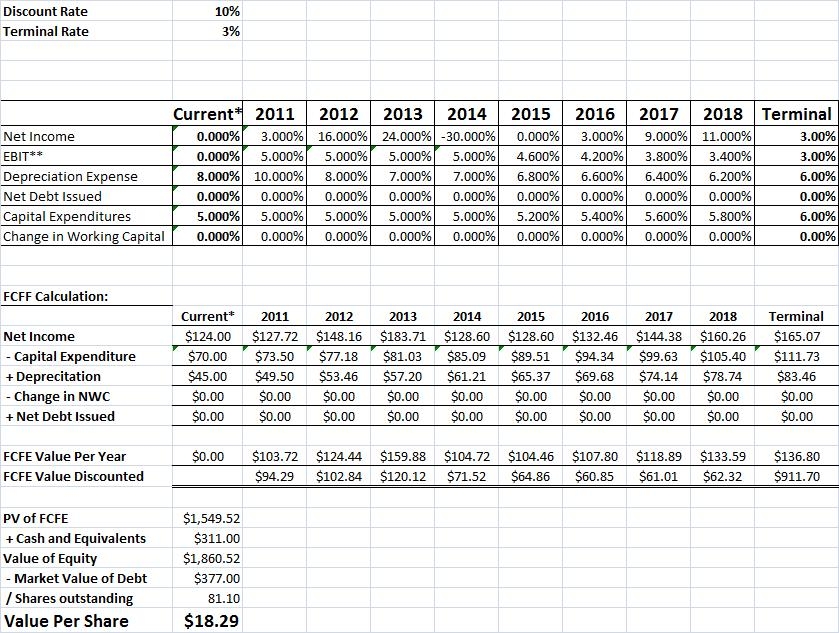
I ran a discounted cash flow analysis on DSX. Please click on the image below to view my assumptions/calculations;
[click to enlarge]

My profit assumptions are in line with the cyclical nature of the business, aka: volatile swings in net income. Capital expenditure and depreciation assumption are based on the implications of recent capital expenditure. I obtain an intrinsic price of $18.29. The current market price is $12.02, offering a margin of safety equal to 34.28%.

Conclusion
The future of the dry bulk shipping industry is uncertain. What is certain, is that shipping is a cyclical industry, and has been suffering tremendously in the past couple years. Macroeconomic trends suggest that a recent surge in commodity prices should have increased shipping rates. This has not happened, and the dry bulk shipping industry stands to increase from catch-up in shipping rates to commodity prices. Diana Shipping has a diverse commodity shipping profile, with higher than average focus on grains.

In terms of financials, Diana Shipping has low leverage, and high profitability. Management has shown good performance through capital allocation decisions, impressive return on capital, and recent share buybacks. The stock price took a massive 60% tumble in late 2008 and while the rest of the market has recovered, it has stayed depressed. Today, Diana is an industry leader that is valued similarly amongst its competitors. By historical standards, it's trading at half of its valuation from its early 2008 highs. A discounted free cash flow analysis shows DSX exhibited a large margin of safety. An investment in Diana Shipping at $12.02 presents an opportunity of above industry average returns if dry bulk shipping remains grim, and great returns in the event of a turnaround in shipping. 

Disclosure: I do not OWN DSX.

DHT Maritime: A Value Play on Rising Rates

DHT Maritime (DHT) operates in the highly competitive crude oil shipping market. Their fleet consists of 3 very large crude carriers (VLCCs), 2 suezmax tankers, and 4 aframax tankers. In addition, the company recently bought a fourth VLCC (built in 1999) for $55mm.


I first became attracted to the company through this activist filing. Normally, I try to stay away from industries like this one; there is no competitive advantage or moat possible, rates are notoriously volatile, leverage ratios are high, etc. However, the filing laid out a great case for the stock to appreciate, noting it was materially undervalued compared to its peers. What really attracted to me to this, though, were the contracts they had signed for all of their ships, which had been locked into at or near the top of the market. These call for a mimimum base charter, and allow for DHT to capture around 1/3 of the prices above this base charter rate. With charter rates currently depressed, these contracts have proved to be a godsend for DHT, as they have enabled them to collect much more than they would if their ships were on the spot market.


What created the opportunity in this stock was historic mismanagement during the economic downturn. The company paid out all of their free cash flow (FCF) as a dividend until the beginning of 2008, when they set their dividend to a fixed rate of 25 cents per share. They continued to pay this dividend even as the stock market and economy cratered throughout 2008. They could do this because of the stability of cash flow from their chartered contracts. Then, in March 2009, the company raised equity for, in my mind, no good reason (the stated reason was to pay down debt, but the company wasn’t in violation of their covenants). The price they raised equity at implied a dividend yield of almost 25%, so why they raised equity instead of cutting the dividend and using those funds to pay debt I’ll never understand. Anyway, the new equity made the dividend unsustainable, and the company eventually had to cut their dividend due, in large part, to all of the new equity they raised (aren’t CEOs great?).

Flash forward to today. The company now has installed a new and seemingly talented management team. The company still has over a year left on all of their charter contracts (the first of the contracts don’t expire until April 2012, and could be renewed until as late as 2019). These contracts GUARANTEE the company will earn at least $40mm in FCF per year, which easily covers their new dividend payments of ~20mm annually.

The company trades for an EV of ~450mm and market cap of ~225mm. So an investor today gets a company with huge leverage and stable cash flows PLUS a call option on potentially rising tanker rates in the form of the profit sharing from the contracts and the newly purchased VLCC (which will go on the spot market).

The company also is kind enough to announce the appraised value of their fleet on their conference calls. With the recent purchase of the VLCC, the appraised value of the ships is just over $415mm. With EV at ~$440m, the investor is paying a premium of ~25m (around 5% of the value of their ships) as a premium for the cash flow guarantees and an option on rising tanker rates and prices.
So I think DHT is slightly undervalued at today’s prices. I can think of three types of people who would benefit from taking a harder look at DHT.

First, investors looking for a high dividend yield - DHT yields in excess of 8%, and the payout is well covered by the cash flows from the contracts. Second, investors who are looking for a way to pay a potential rise in tanker prices. DHT won’t benefit as much as its competitors who have their entire fleet completely on the spot market in such an environment, but they will benefit, and an investor doesn’t have to worry as much about the downside its competitors have in case rates collapse. Rising oil = Rising rates = rising tanker prices. The stressed capital markets + low rates have resulted in extremely depressed tanker prices, and as the global economy continues to recover tanker prices should continue to rise.

However, the main reason I wrote about this stock is for value investors. In the event that the market pulls back and takes DHT along with it, it could create an excellent value buying opportunity to pick the company up for below the value of their ships and earn the the contractually guaranteed cash flows for free.

Disclosure: I do not OWN DHT shares.

Saturday, February 19, 2011

Claymore’s New ‘SEA’ ETF Sets Sail

Claymore Securities, the Lisle, Ill.-based money management firm known for its niche investment strategies, relaunched its shipping industry ETF “SEA” after being forced to close a previous version of the fund in April.

In an ETF-industry first, Claymore was forced to shut down SEA after a shareholder vote related to Claymore’s acquisition by Guggenheim Partners in October didn’t attract enough voters to establish a quorum. The vote was required to approve a change in the fund’s investment advisers. Claymore said at the time that it planned to open a new shipping fund as soon as possible, hopefully with the same ticker.

Claymore has made good on that pledge. The Claymore Shipping ETF fund is listed on the New York Stock Exchange, with the same ticker (NYSEArca: SEA) and with the same expense ratio of 0.65 percent. The original SEA, launched in August 2007, had gathered almost $153 million by the time it closed.

Claymore Managing Director William Belden has said that the situation was extraordinary, particularly in view of the fact that none of Claymore’s other funds that had to conduct the same get-out-the-vote drive failed to obtain the required 50 percent quorum.

Belden added that the fact that many investors used SEA as part of short-term, sector rotation strategies meant that some shareholders no longer owned the fund by the time Claymore solicited their votes. Many held their SEA shares anonymously, making the vote-gathering challenge more significant, he said.

Disclosure I am Long SEA shares. 

Friday, February 18, 2011

Ship Finance (SFL) Posts Q4 EPS of 49c; Raises Qtr. Dividend by 5.5% to 38c/Share

Ship Finance International Limited (NYSE: SFL) reported Q4 EPS of $0.49, $0.06 better than the analyst estimate of $0.43. Total operating sales came in at $71.2 million.

Raises its quarterly dividend by 5.5% from 36c to 38c/share.

Disclosure I am long SFL shares.

Monday, February 14, 2011

Nordic American Tanker Announces Dividend for the 54th Consecutive Quarter Since the Autumn of 1997

Link to the complete 4Q10 dividend report:
http://hugin.info/201/R/1488489/423906.pdf

Nordic American Tanker Shipping Ltd. ("NAT" or "the Company") announced today that the Company has declared a dividend of $0.25 per share for 4Q10, the same dividend as for 4Q09. The dividend policy will continue. The Company has a very strong balance sheet and we shall protect this position.

The Company will pay the dividend of $0.25 per share on or about March 4, 2011 to shareholders of record as of February 24, 2011. After the first three vessels were delivered in the autumn 1997, NAT has always paid a quarterly dividend; including the dividend for 4Q10 the total dividend payment amounts to $41.84 per share.

Including two newbuildings there are now 19 vessels in our fleet of which 15 vessels were trading during 4Q10. At the end of 2011 we expect to have a minimum of 19 vessels trading, representing a substantial increase in earnings and dividend capacity as vessels are being phased in during 2011. The Company remains committed to its strategy of dividend accretive growth and a strong balance sheet. This financial position of NAT is particularly important in a soft market when some tanker companies are experiencing financial difficulties.

Going forward the Company will continue to focus on accretive growth through acquisitions and on keeping the average age of the fleet low. The Company is pursuing a disciplined investment policy. We encourage investors wishing to receive dividends and to have exposure to the tanker sector to assess our model and invest in our Company.

The key points:
  • We will continue our dividend payout policy. The Board has declared a dividend of $0.25 per share for 4Q10.
  • Earnings per share in 4Q10 were -$0.27 of which $0.05 were related to non-recurring items. Earnings were -$0.10 per share in 4Q09. The operating cash flow was $5.2m in 4Q10 compared with $10.5m in 4Q09. In December 2010, NAT took delivery of the suezmax newbuilding Nordic Vega.
  • All our trading vessels are now in the Gemini suezmax cooperative arrangement. We are pleased with this cooperation which ensures efficiency in our commercial operations.
  • The Gulf Scandic -- now Nordic Harrier -- was on a long term fixed contract that expired in 3Q10. The vessel was redelivered to us in October 2010 and is now in drydock as it was not in a contractual condition on redelivery. The vessel is expected to commence trading in late March 2011.
  • In 4Q10 the total offhire was about 8 days for the trading fleet -- a very satisfactory performance.
  • We continue to retain focus on cost efficiency -- both in the administration and onboard the vessels.
  • The Company does not engage in any type of derivatives.
  • The piracy situation in the Gulf of Aden and in the Indian Ocean is of great concern. The Company is taking protective measures to safeguard crew and assets.
  • Towards the end of 2010 there was a certain improvement in the spot market, although modest. However, the market has since then been weak so far in 2011. Going forward, rates may change quickly and unexpectedly. As a matter of policy the Company does not attempt to predict future spot rates.
Dividend Capacity

The Company will continue to keep a strong balance sheet with no or little net debt.
The Company is also in a good position to take advantage of strong shipping markets, which will translate into increased dividend payouts. When the market is down we do not "cut" the dividend, we adjust it, depending upon the general spot market freight level for suezmax tankers.
Below is a chart indicating the annual dividend capacity based on a fleet of 20 vessels and 24 vessels at different spot market rates and today's sharecount.

Link to the graph: http://hugin.info/201/R/1488489/423906.pdf

The above is based on 355 income days per vessel per year. The net debt will be about $7m per vessel with a cash break-even level of $11,300 per day per vessel for a 20 vessel fleet. The graph shows the substantial dividend capacity of NAT.

We see that prices for second hand vessels have softened. Should this development continue, we shall be in a position to acquire further vessels inexpensively compared to historical levels. Such acquisitions would increase the dividend capacity of the Company. It is a prerequisite for any expansion of the fleet that the dividend and earnings capacity per share will increase.

When the freight market is above the cash break-even level, the Company can be expected to pay a dividend. The breakeven rate is the amount of average daily revenues our vessels would need to earn in the spot market in order to cover our vessel operating expenses, voyage expenses, if any, cash general and administrative expenses, interest expense and other financial charges.

The annual spot rates as reported by R.S. Platou Economic Research a.s. show that during the last 11 years up to the end of 2010, 7 years have produced about $40,000 on average per day per vessel or more. This is reflected in the graph later in this report.

The tightened terms of commercial bank financing and higher margins on shipping loans are challenging for debt-laden shipping companies. By having no or little net debt, NAT is better positioned to navigate the financial seas, as we believe this is in the best interests of our shareholders.
Our primary objective is to maximize total return[1] to our shareholders, including maximizing our quarterly cash dividend.

The Company has further acquisitions under evaluation and will work to continue to strengthen its position compared with that of its competitors.

Financial Information

The Board has declared a dividend of $0.25 per share in respect of 4Q10 to shareholders of record as of February 24, 2011 compared with $0.25 per share for 4Q09 and $0.25 share for 3Q10. The average number of shares outstanding for the fourth quarter of 2010 was 46,898,782 -- the same as at the end of 3Q10. The market capitalization of the Company stood at $1.2 billion as of February 11, 2011. It is important to have a sizable market capitalization in order to provide for good liquidity in the share.

The Company's operating cash flow[2] was $5.2m for 4Q10, compared to $10.5m for 4Q09.
We consider our general and administrative costs per day per vessel to be at a low level. We also continue to concentrate on keeping our vessel operating costs low, while always maintaining our commitment to safe vessel operations. We in particular focus on cost synergies of operating a homogenous fleet.

At the time of this report, the Company has no net debt and has a revolving credit facility of $500m of which $75m has been drawn. The credit facility, which matures in September 2013, is not subject to reduction by the lenders and there is no obligation to repay principal during the term of the facility. The Company pays interest only on drawn amounts and a commitment fee for undrawn amounts.
Several publicly traded tanker companies have significant debt, which could make it difficult for them to buy vessels in a weak market.

The table below gives the annual dividend payments as well as quarterly dividend payments for the past 13 years -- the dividends are essentially based on earnings and operating cashflow in the preceeding quarter.

Link to the graph: http://hugin.info/201/R/1488489/423906.pdf


As reported earlier, the Company did not take delivery of a newbuilding (Nordic Galaxy) in August 2010 as it was not in a deliverable condition. This vessel will not join our fleet. We have debited the profit & loss account by a one-time charge of $1.5m related to direct costs of this newbuilding. We will claim this amount from the seller of the vessel as one component in the arbitration process. The parent company (First Olsen Ltd.) of the seller has not repaid an amount under an on demand guarantee that the parent company of the seller has provided in favour of our Company. The guarantee covers a loan our Company has extended to the seller. This amount of $26.8m is included in current assets pending the outcome of the arbitration.

We are entitled to 9% p.a. interest of the outstanding amount pending the outcome of the arbitration. The interest income has not been recognized in the accounts for 2010. We believe that we have a good case. However, if we should lose the Nordic Galaxy arbitration on all claims, the claims in total of the seller of $26.8m translates into approximately $0.60 per share. The outcome of the arbitration will not impact the dividend going forward.

As announced in our 3Q10 report on November 5, 2010, the Company has had no equity incentive plan since the stock options under the 2004 Stock Incentive Plan were exercised in 2009. In 2011 the Board of Directors has decided to establish a new incentive plan involving a maximum of 400,000 restricted shares of which 326,000 shares have been allocated among 23 persons employed in the management of the Company, the Manager and the members of the Board. These allocated shares constitute 0.7% of the outstanding shares of the Company. The vesting period is 4 year "cliff vesting", that is, none of these shares may be sold during the first four years after grant and the shares are forfeited if the grantee leaves the Company before that time. The Board considers this arrangement to be in the best interests of the shareholders and of the Company.

For further details on our financial position for 4Q10, 3Q10, 4Q09 and the twelve months ended December 31, 2010 and 2009, please see later in this release.

Corporate Governance/Conflict of Interests

As advised shareholders, on September 23, 2010 the New York Stock Exchange Commission presented its final report on Corporate Governance. The Commission achieved consensus on 10 core principles. These principles include a) building long-term sustainable growth in shareholder value for the corporation as the board`s fundamental objective, b) the critical role of management in establishing proper corporate governance, c) good corporate governance should be integrated with the company`s business strategy and objectives and d) transparency for corporations and investors, sound disclosure policies and communication beyond disclosure. We believe the principles presented are key elements of good corporate governance and we believe that the Company is in compliance with these principles.

It is very important for NAT to ensure that there is no conflict of interests among shareholders, management, affiliates and related parties. The interests must be aligned. It is intolerable to have conflicts of interest among shareholders, management, affiliates and related parties. We will ensure that there is transparency related to transactions with affiliates and/or related parties.

The Fleet

The Company has a fleet of 19 vessels including 2 newbuildings. By way of comparison, in the autumn of 2004, the Company had three vessels; at the end of 2005 the Company had eight vessels; and at the end of 2006 the Company had 12 vessels. At the end of 2009 we had 15 vessels in operation. At the end of December 31, 2010 we had a fleet of 17 vessels excluding two newbuildings. Please see the fleet list below. We expect that the expansion process will continue and that further vessels will be added to our fleet.
 
Vessel   Dwt   Employment
Nordic Harrier   151,475   In drydock up to approx. end of March 2011, and then spot.
Nordic Hawk   151,475   Spot
Nordic Hunter   151,400   Spot
Nordic Voyager   149,591   Spot
Nordic Fighter   153,328   Spot
Nordic Freedom   163,455   Spot
Nordic Discovery   153,328   Spot
Nordic Saturn   157,332   Spot
Nordic Jupiter   157,411   Spot
Nordic Cosmos   159,998   Spot
Nordic Moon   159,999   Spot
Nordic Apollo   159,999   Spot
Nordic Sprite   147,188   Spot
Nordic Grace   149,921   Spot
Nordic Mistral   164,236   Spot
Nordic Passat   164,274   Spot
Nordic Vega   163,000   Spot
Nordic Breeze   158,000   Delivery expected in 3Q11
Nordic Zenith   158,000   Delivery expected in 4Q11
Total   2,973,410        

The Nordic Harrier (ex Gulf Scandic) was redelivered to the Company in October last year and went directly into drydock for overhaul. The drydock period could last up to end March 2011 after which the vessel will be employed in the Gemini suezmax cooperation. Our company will claim the bareboat charterer to pay for the relevant docking and other costs that are their obligation to cover under the bareboat charter.

Total offhire for 4Q10 was 8 days for our trading fleet. The time out of service for the Nordic Harrier is excluded from the offhire calculation as the ship is expected to commence trading for our account in late March 2011.

World Economy and the Tanker Market
In our quarterly reports to shareholders we have often stressed the significance of the development of the world economy for the tanker industry. The outlook for the world economy is presently uncertain. The tanker markets rates are also affected by newbuildings which enter the markets. As a matter of policy the Company does not attempt to predict future spot rates.

The average daily rate for our spot vessels was $14,400 per day net to us during 4Q10 compared with $17,525 per day for 3Q10. In a low market the vessels may be waiting to get a cargo while in a more robust market environment waiting days are minimized.

Link to the graph: http://hugin.info/201/R/1488489/423906.pdf

The graph above shows the average yearly spot rates since 2000 as reported by R.S. Platou Economic Research a.s. The rates as reported by shipbrokers and by Imarex may vary from the actual rates we achieve in the market, but these rates are in general a good indication of the level of the market.

Strategy going forward
We believe that the operating model of the Company is working to the benefit of our shareholders. Transparency is very important for NAT.

The financial turmoil and depressed shipping markets provide attractive opportunities for expansion.
Our objective is to have a strategy that is flexible for both a strong shipping market and a weak shipping market. If the market is strong, good results and dividends can be expected. If the market is weaker, dividends will be lower. However, if rates remain low, the Company is in a position to buy vessels inexpensively by historical standards, paving the way for even higher dividends when the market strengthens again. In this way, the Company has covered both scenarios.

After an acquisition of vessels or other forms of expansion, the Company should be able pay a higher dividend per share and produce higher earnings per share than had such an acquisition not taken place.

Our full dividend payout policy will continue to enable us to achieve a competitive risk adjusted cash yield over time compared with that of other tanker companies.

Our Company is well positioned. To the best of our ability we shall endeavor to safeguard and further strengthen this position for our shareholders in a deliberate and transparent way.

[1] Total Return is defined as stock price plus dividends, assuming dividends are reinvested in the stock
[2] Operating cash flow is a non-GAAP number. Please see later in this announcement for a reconciliation of operating cash flow to income from vessel operations.

CAUTIONARY STATEMENT REGARDING FORWARD-LOOKING STATEMENTS
Matters discussed in this press release may constitute forward-looking statements. The Private Securities Litigation Reform Act of 1995 provides safe harbor protections for forward-looking statements in order to encourage companies to provide prospective information about their business. Forward-looking statements include statements concerning plans, objectives, goals, strategies, future events or performance, and underlying assumptions and other statements, which are other than statements of historical facts.

The Company desires to take advantage of the safe harbor provisions of the Private Securities Litigation Reform Act of 1995 and is including this cautionary statement in connection with this safe harbor legislation. The words "believe," "anticipate," "intend," "estimate," "forecast," "project," "plan," "potential," "may," "should," "expect," "pending" and similar expressions identify forward-looking statements.

The forward-looking statements in this press release are based upon various assumptions, many of which are based, in turn, upon further assumptions, including without limitation, our management's examination of historical operating trends, data contained in our records and other data available from third parties. Although we believe that these assumptions were reasonable when made, because these assumptions are inherently subject to significant uncertainties and contingencies which are difficult or impossible to predict and are beyond our control, we cannot assure you that we will achieve or accomplish these expectations, beliefs or projections. We undertake no obligation to update any forward-looking statement, whether as a result of new information, future events or otherwise.
Important factors that, in our view, could cause actual results to differ materially from those discussed in the forward-looking statements include the strength of world economies and currencies, general market conditions, including fluctuations in charter rates and vessel values, changes in demand in the tanker market, as a result of changes in OPEC's petroleum production levels and world wide oil consumption and storage, changes in our operating expenses, including bunker prices, drydocking and insurance costs, the market for our vessels, availability of financing and refinancing, changes in governmental rules and regulations or actions taken by regulatory authorities, potential liability from pending or future litigation, general domestic and international political conditions, potential disruption of shipping routes due to accidents or political events, vessels breakdowns and instances of off-hire, failure on the part of a seller to complete a sale to us and other important factors described from time to time in the reports filed by the Company with the Securities and Exchange Commission, including the prospectus and related prospectus supplement, our Annual Report on Form 20-F, and our Reports on Form 6-K.

4Q10 dividend report: http://hugin.info/201/R/1488489/423906.pdf

Disclosure I am Long NAT shares. 

Sunday, January 16, 2011

Floods hamper Rio aluminium deliveries

Rio Tinto Ltd says Queensland's flood crisis is preventing some deliveries of aluminium from its giant Boyne smelter. Boyne Smelters Ltd, 59.4 per cent owned by Rio Tinto Alcan, is Australia's largest aluminium smelter, and is located near Gladstone in central Queensland.

Rio issued a force majeure, a contractual clause that gives companies the ability to miss deliveries due to circumstances beyond their control.

"The floods have cut road and rail access between Gladstone and Brisbane and the Brisbane port is closed, preventing deliveries to some domestic and international customers," Rio said in a statement.
"Rio Tinto Alcan is investigating alternative arrangements for customers, including shipping aluminium directly out of the Gladstone port.

"Rio Tinto Alcan is currently unable to provide an estimate of the full impact of the disruption to the supply of aluminium from Boyne Smelters Limited or the duration of the force majeure declaration," it said.

Last month Rio was forced to issue a force majeure for coal sales contracts from mines in which it has a majority interest in Queensland's Bowen basin. Queensland's flood crisis has seen at least 15 people perish and left thousands of homes flooded and without power.

Disclosure I am long RIO Shares

Saturday, January 15, 2011

3 Shipping Stocks That Are Cruising

Shipping rates for supertankers are on the rise, largely due to increased fuel demand from China. That increase is causing analysts to predict a rise in the daily shipping rate to $100,000 by December of this year. It's good for the shippers - and maybe for China, too - but it might be a tad inflationary for the average consumer at the gas pump going forward.

For investors, it clearly means opportunity. The shipping business is on the mend, and below we list three stocks whose fortunes are proving that fact. Note, too, that it's more than just price appreciation that makes these companies attractive. They also boast some spectacular fundamentals.


Knightsbridge Tankers Limited (Nasdaq:VLCCF) has a market cap of over $320 million and trades with an annual dividend yield of 8.5%. Better than this, however, is the stock's performance; year-to-date, Knightsbridge shares have climbed more than 40%. That beats the iShares Dow Jones Transportation Average ETF (NYSE:IYT) by a long shot. The transports are up less than 5% since the year began, and the broad market, as measured by the SPDR S&P 500 ETF (NYSE:SPY), is down nearly 2%.
Knightsbridge operates a fleet of dry bulk and crude oil carriers and is headquartered in Bermuda. The stock's P/E ratio is 12.2 and price-to-book is just 1.27. L4
In June, VLCCF added another capesize vessel, the Golden Future, to its fleet at a cost of $72 million.

Strong Five-Year Growth Trend

Seaspan Corporation's (NYSE:SSW) sales figures have grown at a rate of 51% for the last five years and EPS growth comes in at 56% for that period. Yet the stock still offers an ample 4.8% dividend yield and trades with a P/E of 18.5. Moreover, the shares are on offer at just a fraction of the company's breakup value. Price-to-book is a meager 0.69.
Seaspan owns and operates a fleet of 42 containerships and has contracts to purchase another 21 and lease five more. The company is domiciled in Hong Kong. Year-to-date the shares are up 14.5% and for the full year an impressive 70%.

Comparatively, Teekay Corporation (NYSE:TK) stock has risen by over 13% since the year began and by 47% for the full year. The stock pays a 4.9% dividend and trades with a P/E of 15.1.

The Final Straw

Hop on the next ocean going transport to wealth and riches. The above three issues offer great recent momentum and a nice yield kicker, to boot. (Despite some disappointing trucking trends, there is still a lot of opportunity in the industry.)

Disclosure I am long VLCCF, and SPY shares. 

Sunday, July 18, 2010

Recent Buys and current news

July News is in so far. On 7/6/10 I purchased EOS, FSC and PFE $8.00 each company. On 7/13/10 I purchased ED, IBM, BPT at $8.00 each. My june statement has arrived. Equities and stock for June $351.11 value at may end was $261.44. Dividends for the month Jumped to $2.25 from .79 cents the period before.


    My top three holdings for June were GE 1.594 Shares $22.99, 2nd IGD 1.9271 shares $20.06, and #3 is AOD 3.7947 shares $18.78. Top 3 dividends in June were AOD .44 cents , FRO .25 cents, DO Special Dividend .13 cents Regular Dividend .01 cent. Total of 12 buys for June. Total 33 dividends collected in June.

Well thatis it for now cheers all.

Sunday, June 20, 2010

Wowzers Were did da time go.............

     I stumbled across my password the other day finally can do some updated. The wife had a heart attack I had to sell all that had at folio investing and recover the family. I now have a roth ira through sharebuilder.com Get ya own Account here. I am still using the same investing style as before. I put in 50.00 every payday and invest $5.00 for each day that I work (Kinda like a reward for having to go to work and deal with all the drama everyday that goes with work). With that being said my first deposit was on 4-16-2010. My account today stands at $346.21. I am a subscriber to the plan so I pay a flat $12.00 per month for 12 trades per month. I am long 52 different holdings in what I think is a pretty diversified portfolio. My current Holdings ranked by the amount held in the account 1 being my biggest holding and 52 being my smallest.

    My current holdings include the following, AOD, IGD, MRK, WMT, TNH, FRO, DO, GE, XOM, INTC,  PHK, EOS, PTY, DPD, IID, PHT, GDX, NLY, BMY, CTL, VNQ, CFP, CAH, KMB, O, PEP, SYY, CAT, PG, TPZ, ESD, LQD, EOI, ABT, PGX, JNK, PFF, VWO, GGN, MMM, IGI, BDX, XLF,  BAX, FSC, SPY, PFE, ED, KMP, BPT, IBM, AND BP.Those are all my holdings that i plan to stick with for now and the ones I talk about on my blog. In my challenge to beat the company sponsored 401k.

         I try to invest with a huge focus on dividends and reinvesting of the dividends you can not beat having your money working for you. Most of the time if a holding cuts its dividend I will sell it the next chance I get (however different in the case of bp). As this stock i am not sure what to do with so I will just hold it for the time being.

       Dividends Paid this month include, INTC, PFE, WMT, DO on 6-1-2010, LQD, PFF on 6-7-2010, JNK on 6-9-2010, IBM on 6-9-2010, XOM, MMM on 6-14-2010, ED, IGD, IID, and O on 6-15-2010 and CTL on 6-21-2010. All dividends are automatically reinvested back into the same stock they come from.

       I purchased DO, IGI, FRO, GDX and PHT on the 6-01-2010 value $5.00 each. On 6-8-210 I purchased AOD 2.05 shares for $13.00 and 1.1321 shares of IGD for $12.00. On 6-15-210 I purchased 0.3422 shares of MRK for $12.00 and 0.2525 shares of WMT for $13.00. And next week I plan to purchase on Tuesday $12.00 worth of IBM and $13.00 worth of ED.

      It seems like it is taken for ever to get this going all over again, but I know Rome wasn't built in a day. So I be using this blog to share my thoughts and current investments. Feel free to follow along with me as I try to once again build a nest egg of money working for me.

Saturday, September 26, 2009

DHT Maritime Inc. Not To Declare Dividend For Second Quarter Of 2009

DHT Maritime Inc. announced that the Board of Directors has decided not to declare any dividend for the second quarter of 2009.

Therefore DHT no longer meets my demand for payment from my holdings. I will be selling my holding on Monday. I will no longer speak of DHT unless a decent payout dividend record is reestablished.

Friday, August 7, 2009

Nordic American Tanker (NAT) Declares $0.50 A Share Dividend, Yielding 11.71%

The Company will pay a dividend of $0.50 per share on or about September 4, 2009, to shareholders of record as of August 21, 2009.

To receive this dividend, you must own your shares by August 19th.

Nordic American Tanker Shipping (NAT) said it swung to a second-quarter loss of $137,000, as net voyage revenue dropped to $29.7 million from $63.2 million. It earned $35.5 million in the year-earlier period. It said earnings per share from continuing operations were 9 cents a share. Analysts polled by FactSet had expected earnings of 5 cents a share. The company will pay a dividend of 50 cents per share on or about Sept. 4, 2009, to shareholders of record as of Aug. 21, 2009, down from 88 cents in the first quarter.

Disclosure I am long NAT shares.

Current Catalog

Friday, July 31, 2009

Norfolk Southern (NSC) Declares Qtr. Dividend of $0.34

Norfolk Southern Corporation (NSC - Quote) today announced the regular quarterly dividend of 34 cents per share on its common stock, payable on Sept. 10, to stockholders of record on Aug. 7.

Since its inception in 1982, Norfolk Southern has paid dividends on its common stock for 108 consecutive quarters.

Norfolk Southern Corporation is one of the nation's premier transportation companies. Its Norfolk Southern Railway subsidiary operates approximately 21,000 route miles in 22 states and the District of Columbia, serves every major container port in the eastern United States, and provides efficient connections to other rail carriers. Norfolk Southern operates the most extensive intermodal network in the East and is a major transporter of coal and industrial products.

Disclosure I am long NSC shares.

National Wildlife Federation

International Shipholding (ISH) Reports 38% Drop in Q2 Earnings; Declares $0.50 Qtr. Dividend

International Shipholding Corporation (ISH - Quote) reports Q2 EPS of $1.46, compared to $2.37 in the same quarter last year. Revenue for the quarter was $99.82 million, versus $61.15 million in Q208.

Declared a second quarter dividend of $0.50 per share payable on September 1, 2009 to shareholders of record as of August 17, 2009.

Disclosure I am long ISH shares.

Dress Code Formal- July 4th

Thursday, July 23, 2009

Burlington Northern (BNI) Approves $0.40 Qtr. Dividend

Burlington Northern Santa Fe Corporation (BNI - Quote) today declared a quarterly dividend of $0.40 per share on outstanding common stock. The dividend is payable on October 1, 2009, to shareholders of record September 10, 2009.

The ex-dividend date is September 8.

The dividend currently yields 2.03%.

Disclosure I am long BNI shares in my shipping Folio.

Apple iTunes

Weekly update on 8 folios and recent transactions, Retire on $5.00 per day each day market open

Well not a lot going on with the buy and selling in my 8 folios but here is a breakdown of my recent activity.

Basic materials folio which includes my commodities picks. Currently I am long 17 picks and will be selling one tomorrow. I am long, IPHS,DO,KWR,TYG,EEQ,BP,KMR,NUE,
GNI,DJP,E,BPT,CVX,SLV,GLD, AND GGN. Combined this folio is up 12.24% year to date not including dividends. I will be selling RJI tomorrow, taking a small 5 to 6 % profit.

In my bonds and closed end fund folio, (fixed income) all pay monthly dividends. I am currently long. IID, DPO, IGD, EOS, MAIN, AOD,ESD,JNK,HYG,PCY,PSEC,LQD, and BND. This folio is up 13.54% year to date. No changes this week.

In my financial and reit folio. I am long 15 stocks. This folio is up 10.10% year to date. Top pick AGNC and AFL, my 2 laggers are ESS and CMO. I just repurchased CMO this week after selling it last week for 34% profit. No other changes.

My consumer goods and consumer services folio, all but shipping stocks. Currently is long 11 stocks. MMM and CALM leaders, with SYY a lagger. This folio is up Year to date 10.94% no changes for this folio either.

My index etf and emerging markets etf folio. Currently long 11 etfs, with FXI and VWO leading the way. Even my lagger EFA is up 7.76%. This folio is up 13.36% year to date.
No changes at this time.

My industrial goods and healthcare folio. Contains 17 picks with CAT and GSK at the clear winners, ABT and ECOL the laggers. This folio is up 10.70% year to date. Recently Purchased CAH which is already up 7.83% since my initial purchase. No other changes.

My shipping and railroad folio. By far the healthiest and hottest folios of all lately. Currently long 14 stocks with CSX, SFL, leading the way, and the laggers are GMR and DHT. This folio is up currently 17.17% year to date. No recent changes to this folio.

And my last folio is my utilities and tech folio. Currently long 15 stocks, with INTC, TEG as the winners. The laggers are CTL and ADP. This folio is currently up 11.81% year to date. No recent changes to this folio at this time.

So my total portfolio consisting of 8 folios is up 12.53% year to date, which does not include dividends. I have received 2.24% in dividends this year to date. I still dollar cost average every single day the market is open. I have not missed one trading day this year. I add $5.00 a day spread across each folio plus reinvest the dividends back to who paid them. If a stock cuts its dividend I sell it period.

My core is 112 stock, etfs and closed end funds. The cream of the crop according to my eyes, my value and my long term holding period. I plan to hold this dividend paying stocks until further notice As I try to spank the shorts of my 401k provided through my employer with Principal Financial Group.

Now to my 401k my work currently matches 50% of the first 6 percent so that is all i put there i put the rest in my above mentioned Roth ira account at Folioinvesting.com.

Currently up year to date in my 401k, 18.81% before fees, god only knows how much they will be. Received $7.82 in dividends year to date, versus $40.29 through june in my roth ira.

In closing I am very excited to be playing the market, living, breathing and smelling the stocks. Dow broke 9000 today I used to watch everyday to see what happened, course i still do but nothing seems to matter now that I have plan and stick to it. My core is built and I am in the accumulate phase of my retirement plan. No matters what happens I have am on this train. I go to the coal mines shovel in hand(aka my work place). Do the best I can and try to add to my folio more money everyday.

Sometime I ponder how this all started with just $ 1.00 a day investing in my favorite stocks, at the start of this year I opened this roth ira and now I am off to the races(LOL). So yes you can retire at just 5.00 a day every day the market is open. Yes I do see some ups and downs in the future. But this is so much better than smoking, drinking, gambling and parting away all my money never having a pot to piss in so to say. Now I can see the light I feel better, look better, am happier and have a pot to piss in now.

Please feel free to comment on this or any of my other stories, I have gathered here on my blog. Only through each other can we prosper together. Thanks for taking the time to read my blog, I only hope I can show the light to one more person out there somewhere.


Disclosure I am long all stock mentioned in this blog as well and many that were not motioned. Please if you do invest do your own research what works for me many not work for all I am not a licensed broker at this time but sure hope to be very soon.


Paradysz Matera

Monday, July 20, 2009

Time to COnsider SHipping ETF's, Sea is my choice

When countries around the globe start resuming business as usual, shipping will be a given necessity and exchange traded funds (ETFs) are one way to gain access to this sector and satiate your investment needs.

The Claymore/Delta Global Shipping (SEA) reflects the Delta Global Shipping Index, which measures the performance of maritime shipping industry firms in global developed markets, writes Don Dion for TheStreet. The ETF’s portfolio has dry bulk goods and the leasing and/or operating of tanker ships, container ships, specialty chemical ships and liquefied gas or dry bulk goods transport ships.

SEA has 30 holdings with an expense ratio of 0.65%. The fund has a 58.7% allocation in industrials and 41.3% allocation in energy. The components within the fund are based on market capitalization and liquidity.

Investors are coming back into shipping, realizing that countries such as China are demanding materials en masse. More recently, the shipping industry is being driven by steel demand and higher demand from China and emerging markets will likely raise rates on dry bulk shipping.

When talking about the shipping industry, the most important ratio is “bottoms,” or number of ships, to demand for transported goods. If there are more products than bottoms then the rates are high; if there are more bottoms than cargo, then rates are low.

* Claymore/Delta Global Shipping (SEA): up 17% year-to-date

Disclosure I am long SEA in my shipping folio.

stacyadams.com (Weyco Group, Inc.)

Friday, June 19, 2009

Lets ride the rails With Norfolk Southern (NSC)


Sporting a current P/E of 9.01 and a decent 3.57% dividend. Payout ratio coming in at 29.39% meaning the dividend is pretty safe. My target is $48.57 currently trading at $38.34, making it a solid value play. I started buying/accumulating at $27.12 a share currently up 15% and will keep collecting shares, currently long, BNI, NSC, CSX, PRPX, and UNP in my railroad folio. Up 18.87% year to date in this folio.

Norfolk Southern Corp. is a Virginia based freight railroad company operating primarily in the eastern United States. NSC operates approximately 21,000 miles of railroad across 22 states comprising 2/3rds of the American population. NSC generated its 2008 operating revenues from the following traffic sources: Coal (28%), General Merchandise (52%), and Intermodal– (i.e. standardized containers that are handled and transferred between ships, trucks and rail) (19%).

NSC’s main competitor is CSX Corp but it also competes with other forms of freight shipping especially trucking.

Disclosure I am long all 5 Rail companies in my Railroad Folio.

Refurbdepot.com (Comtech Direct Inc.)

Thursday, June 11, 2009

Overseas Shipholding (OSG) Announces $.4375 Per Share Quarterly Dividend


Overseas Shipholding Group, Inc. (NYSE: OSG - News), a market leader in providing energy transportation services, today announced that its Board of Directors has declared a regular quarterly dividend of $0.4375 per share on the common stock outstanding, payable on August 27, 2009 to stockholders of record on August 7, 2009.

Overseas Shipholding Group, Inc. (NYSE: OSG - News), a Dow Jones Transportation Index company, is one of the largest publicly traded tanker companies in the world. As a market leader in global energy transportation services for crude oil and petroleum products in the U.S. and International Flag markets, OSG is committed to setting high standards of excellence for its quality, safety and environmental programs. OSG is recognized as one of the world’s most customer-focused marine transportation companies and is headquartered in New York City, NY. More information is available at www.osg.com.

Disclosure I am long OSG shares.

Thursday, May 21, 2009

Coal, Infrastructure, Added Bank Folio , added Shipping Picks and Duh stopped smoking again

Hello ev1 hope all is having a good day. My nerves are shot I have started to stop smoking again this is Officially day #2 yahoo!! Any way I will do the best I can and will beat this monkey off my back soon I know I can do this with everyone's help. So enough about me on with my recent changes in to my holdings.

I picked up 2 coal stocks ACI, arch coal and picked up the etf KOL from Market Vectors added to my basic material folio. In my shipping folio I added TNK, DHT, and HRZ sold trmd.

Added PXR (PowerShares Emerging Markets Infrastructure Portfolio )to my emerging markets folio.

Sold MCD mcdonalds for 15.2% profit let it go. Have not found a service stock to replace mcd in my services folio yet.

I then took all my sector etfs and split them up into their own folios. Started a Bank Folio, containing approx. 13 picks.

Seems I am out of time for today off to take the wife to the doctor and then to work so have a good day all and thanks for reading my blog.

Tuesday, May 19, 2009

Safe Bulkers, Inc. (SB) Declares Quarterly Dividend of $0.15 per Share

Safe Bulkers, Inc. (NYSE:SB - Quote), an international provider of marine drybulk transportation services, today declared a quarterly dividend of $0.15 per share for the first quarter of 2009.

The Company today declared a cash dividend on its common stock of $0.15 per common share payable on or about May 29, 2009 to shareholders of record at the close of trading of the Company's common stock on the New York Stock Exchange (the "NYSE") on May 22, 2009. The Company has 54,508,907 shares of common stock outstanding as of today.

This is the fourth consecutive cash dividend the Company has declared since its initial public offering on May 28, 2008. The dividend for the first quarter of 2009 was maintained at the same level as that for the previous quarter.

The Board is continuing a policy to pay out a portion of the Company's free cash flow at a level it considers prudent in light of the current economic and financial environment. The declaration and payment of dividends, if any, will always be subject to the discretion of the Board of Directors of the Company, and will depend on, among other things, the Company's earnings, financial condition and cash requirements and availability, the Company's ability to obtain debt and equity financing on acceptable terms as contemplated by the Company's growth strategy, the restrictive covenants in the Company's existing and future debt instruments and global economic conditions.

Disclosure I am long SB shares in my shipping Folio