Your Ad Here
Showing posts with label Consumer-Goods. Show all posts

Sunday, March 6, 2011

What is a Good Dividend Yield?

Dividend yields have a bit of a "Goldilock's porridge" quality about them. Investors have to try different yields while searching for the ones that are just right. Pick one that's too low, and you'll be risking your money and not getting paid for taking on that risk. But pick one that's too high and you could get seriously burned.


Too Low


Investors love dividends. And they have every reason to. A dividend can be, among other things, evidence that a company is:
  1. financially secure; 
  2. confident about future sales trends; and 
  3. willing to share that stability and success with it's shareholders
But just paying any old dividend doesn't automatically qualify you as a good dividend stock.

Consider the case of Halliburton (NYSE:HAL), an oil and gas company with a market cap of over 40 billion. Halliburton's current yield is 0.75%, which is less than what you can get from a 2 year U.S. treasury bill. One of these investment options is backed by the full faith and credit of the U.S. government, and the other one is not (probably).

To qualify as a good dividend yield, it has to compensate investors for the extra risk of owning stocks instead of bonds or bank CDs, so the yield shouldn't be too low.

Too Steady


Consistency is a prized value in dividend stocks. So much so that the S&P 500 has a special class of dividend payers called dividend aristocrats which have raised dividends for at least 25 consecutive years.

But consistency can cut both ways. Take a look at Merck (NYSE: MRK), a pharmaceutical company with a mega-market cap of over 100 billion. It currently sports a hefty yield of over 4.5% which is no small potatoes when 10 year treasury bonds are paying around 3.75% and most bank savings accounts are at less than 1%.

But as with so much of investing, the important aspect of the dividend yield is all about the future, not the present. And that's where Merck comes up short. The company has been paying the same exact dividend for over six years, without a single hike since September of 2004! That's not the kind of consistency that dividend investors hope for. To qualify as a good dividend yield, it has to be growing.

Too High


In early 2008, Harley Davidson (NYSE: HOG) had a dividend yield of $0.33 per share, or over 6%. Investors who were selling Harley stock for fear of what the recession would do to motorcycle sales were right to keep the stock price down, and the dividend was slashed by 70 percent in the next quarter!

To be a good dividend yield, it must be sustainable and shouldn't be temporarily inflated by a low stock price. In other words, it shouldn't be too high.


Just Right


That puts the sweet spot of dividend yields these days at around 3-5 percent. There are plenty of large cap companies paying dividends in this range which have been raising their dividends over the last five years. Running a screen for these metrics yielded about 40 stocks for me. Here are a few picks from the bunch:

Unilever (NYSE: UL)
Market Cap: 84 Billion
Yield: 4.75
Dividend Growth Rate (5 year average): 17%

McDonald's (NYSE: MCD)
Market Cap: 80 Billion
Yield: 3.21
Dividend Growth Rate (5 year average): 29%

Clorox (NYSE: CLX)
Market Cap: 9 Billion
Yield: 3.23%
Dividend Growth Rate (5 year average): 14%
 
Disclosure I am long CLX, MCD and UL shares.

Thursday, February 24, 2011

Colgate-Palmolive (CL) Increases Quarterly Dividend 9% to $0.58

Colgate-Palmolive Company (NYSE: CL) has declared a quarterly dividend of $0.58 per common share, $2.32 annualized. The dividend is a 9% increase from the current rate of $0.53.

The dividend is to be paid on May 16, 2011 to shareholders of record as of April 26, 2011. The ex-dividend date is April 22, 2011.

Yield on the dividend is 3%.

Disclosure none.

Sunday, February 20, 2011

Reynolds American Boosts Quarterly Dividend 8.2% To 53 Cents

Reynolds American Inc. (RAI) raised its quarterly dividend 8.2% as the tobacco company, like many other companies of late, looks to return value to shareholders.

The company boosted the dividend to 53 cents from its previous 49-cent level, bringing the annual rate to $2.12 a share.

"This increase aligns the dividend with the company's recently increased payout target and demonstrates the company's commitment to returning value to shareholders," said President and Chief Executive-elect Daniel Delen.

Many companies have been looking to return value to shareholders in recent months, using their cash piles to buy back stock or implement or boost dividends.

Earlier this month, Reynolds said its fourth-quarter profit climbed 44%, driven by higher pricing and productivity improvements.

Shares rose 0.8% to $33.50 in light premarket trading. As of Tuesday's close, the stock had risen 29% in the past year.

Disclosure None

Borders Declares Bankruptcy

Borders Group (BGP) fought off filing for bankruptcy as long as possible but the bookstore chain couldn’t fight off the inevitable. Today, Borders filed for Chapter 11 Bankruptcy protection.

The bankruptcy filing is horrible news for shareholders of the company. Long suffering shareholders will be wiped out for holding onto this stock. I never understood why anyone was investing in this stock. The long-term fundamentals were horrible. The writing had been on the wall for a long time at Borders.  Amazon and the e-book frenzy have killed off most bookstore chains. The last company standing intact is Barnes & Noble.

Borders bankruptcy filing is however good news for the chain. The company is  seeking to close 30% of its stores and has received access to  $400 million of its $505 million bankruptcy financing from GE Capital. That’s roughly 193 of its 642 stores. Borders is now trying to change its business model by getting more into digital distribution and selling more non book products.

I still don’t see how Borders will reinvent itself. The company is years behind Amazon in the digital distribution game and remains behind Barnes and Noble in the traditional bookstore business. I just don’t think that the market is big enough for Borders to be a viable player.

Back in December of 2008, Borders Group was included in my post about Dead Companies Walking. Since that time Borders and Blockbuster have gone bankrupt. The next big chain that I expect too bankrupt is Rite Aid. The company is suffocating under its massive debt load. Rite Aid’s terrible same store sales numbers can only be explained away by management for so long.

What national chain do you expect to go belly up next?

Disclosure None

True To Form, Coke Raises Dividend 7% Streak Continues Since 1920 has paid Dividends

Coca-Cola (KO) has history that dates back to 1886. It also has a long record of returning cash to shareholders. It has paid dividends each year since 1920, about a year after it began listing on the New York Stock Exchange.

On Thursday, Coca-Cola's board approved lifting its quarterly shareholder payout by 7% to 47 cents a share. The beverage giant cited confidence in its long-term cash flow. This dividend is payable April 1 to shareholders of record as of March 15.

From an annual standpoint, Coca-Cola pays $1.88 a share for a current yield of about 3%. That's the biggest yield among the dividend paying stocks in IBD's Beverages-Non Alcoholic group. The company has raised its dividend for 49 consecutive years.

Coca-Cola is a member of the S&P 500 Dividend Aristocrats index, which is made up of blue-chip companies that have paid increasing dividends each year for at least 25 years. Coca-Cola is also one of billionaire investor Warren Buffett's biggest holdings in his Berkshire Hathaway (BRKA). As of Dec. 31, Berkshire Hathaway owned 200 million shares.

Meanwhile, Dr Pepper Snapple Group (DPS) popped Thursday after posting better-than-expected quarterly results. Thanks to increased demand for Dr Pepper, 7-Up and Sunkist beverages, the company reported Q4 earnings of 67 cents a share, up 52% and 3 cents above views. Sales grew 4% to $1.41 billion, also above views. Both top- and bottom-line growth was the best in years.
Looking ahead, Dr Pepper Snapple expects full-year 2011 profit of $2.70 to $2.80 a share. Analysts polled by Thomson Reuters expected $2.72 a share.

Dr Pepper Snapple Group came about in 2008 after it was spun off from Cadbury Schweppes Americas Beverages.

The company declared its first-ever quarterly dividend, of 15 cents a share, in November 2009. It most recently raised the payout by 67% to 25 cents a share in May.

Earlier this month, the company declared a quarterly dividend of a quarter a share. The annual $1-per- share rate works out to a yield of about 3%.

Disclosure NONE

Clorox: Why This Dividend Aristocrat Deserves More Respect

Popular brand names at Clorox (CLX) include: Clorox bleach, Green Works, Armor All, STP, Scoop Away cat litters, Kingsford, Hidden Valley, K C Masterpiece dressings and sauces, Brita, Glad bags and Burt’s Bees natural personal care products. 70% of the brands hold a #1 market share and another 18% hold a #2 market share position in their categories.
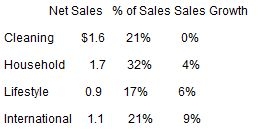
Fiscal 2010 segment results ($ figures in billions) were:


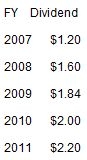
Dividends have been increased annually since 1977, easily qualifying CLX as an S&P 500 Dividend Aristocrat. Last May, the quarterly dividend was increased to 55¢ ($2.20 annualized).

Recent dividend history:

The markets were disappointed with fiscal Q1 results reported in November 2010, causing the low beta stock to drop $4 in 3 days. CLX said:
We faced a challenging economic environment, as evidenced by category softness in the U.S. along with the impact of the Venezuela currency devaluation," said Chairman Don Knauss. "Late first-quarter shipments were particularly soft and that trend has continued into the first weeks of our second quarter. While we're disappointed not to have delivered stronger first-quarter results, we manage our business for the long term. I believe we're taking the right actions to maintain the long-term health of our brands and help strengthen our categories as the economy recovers.
Company guidance given for FY2011 was:
  • 0-2% sales growth
  • 25-50 basis points gross margin growth (unchanged)
  • Diluted EPS from continuing operations in the range of $4.05-$4.20
Two weeks ago, CLX updated the FY2011 outlook. CLX anticipates improved performance in the second half of the fiscal year, including topline growth in the range of 2-4%. For the full fiscal year, CLX guided FY2011 sales of flat to 1% growth. Knauss added,
While second quarter sales results are likely to be a little lower than previously anticipated, as reflected in our updated full year sales outlook, we believe our categories are stabilizing, giving us momentum into the second half of the year, and we should benefit from our recent market share gains. We have a solid new-product pipeline, enabling further growth across a number of categories, and we anticipate improved performance in the second half of the year, including topline growth in the range of 2 percent to 4 percent. Further, the impact of the prior-year Venezuela devaluation and unusually strong year-ago H1N1-related sales will be behind us.
Q2 will have a goodwill impairment charge of $250-255 million ($1.78-1.82 diluted EPS) related to Burt's Bees business (with no tax benefit expected). In November 2010, CLX completed the sale of Auto Care businesses with an anticipated after-tax gain of $171 million. Including the $60 million deferred tax benefit in fiscal Q1, the gain on the sale is expected to be $231 million (reflected in discontinued operations).

Leading household brands at CLX are growing at modest rates in the US and rapidly overseas. In the last 6 years, international sales have been growing 2-3 times the rate of domestic sales. 58% of international sales come from Latin America and only 5% are in Asia (offering large growth potential). International business is expected to account for a substantial portion of future growth

Company EPS guidance for FY2011 remains $4.05-$4.20. Fiscal Q2 results and any guidance updates will be released in the first week of February. Analysts are forecasting EPS of $4.00 in FY2011 and $4.48 for next year. Company finances remain strong, especially after selling the AutoCare businesses which will provide funds to repurchase over 12 million shares of treasury stock in FY2011.

In the last 6 years the stock has largely traded in the $55-65 range while dividends have been growing. At $65, with a P/E of 13X and a yield of 3.4% (the dividend will be raised in May), long term investors who can tolerate current conditions should find CLX an attractive investment.

Disclosure I am long CLX shares.

Saturday, February 19, 2011

Sara Lee (SLE) to Split into Two Public Entities; Sees $3/Share Special Dividend, Offers FY11 Guidance

Sara Lee Corp. (NYSE: SLE) announced that its Board has agreed in principle to divide the company into two separate, publicly traded companies. The separation is expected to be completed in early calendar year 2012.

Under the plan approved, Sara Lee’s North American Retail and North American Foodservice units (excluding the North American beverage business) will be spun off, tax-free, into a new public company that will retain the “Sara Lee” name. Its brands will include Sara Lee, Jimmy Dean, Ball Park, Hillshire Farm, Chef Pierre and State Fair.

The yet to be named other company will consist of Sara Lee’s current International Beverage and Bakery businesses, as well as the North American beverage business. Its leading brands will include Douwe Egberts, Senseo, Pickwick, Maison du Café, L’OR, Café Pilão, Marcilla and Bimbo.

In conjunction with today's news, Sara Lee's Board has said it intends to declare a $3/share special dividend on common stock, the majority of which will be funded with proceeds from the sale of the company’s North American Fresh Bakery business. The special dividend is expected to be declared and paid in fiscal 2012 and before completion of the spin-off of Sara Lee’s North American Retail and North American Foodservice businesses.

Sees FY11 EPS from continuing operations of 82-86c, with sales of $11.9-$12.1 billion and cash flow from operations of about $400-$500 million.

Disclosure NONE and no plans in the future. 

Friday, February 18, 2011

6 Noteworthy Stocks with Yields Over 4%

If you’re looking to boost the total dividend yield of your portfolio, picking up a few stocks yielding 4%, 5%, or 6% can go a long way. One must be careful, of course, to select companies that have sustainable dividend payouts and that are good long-term investments. Although not every one of these may make for a good investment, and readers should do their own more thorough research, here are six high-yielding companies that are worth being aware of.

Altria Group (MO)

Altria is one of the largest tobacco companies in the world, and also has an interest in alcoholic beverages. Depending on the individual investors views on ethical investing, it may or may not meet your requirements for inclusion in your portfolio, but the dividend yield is particularly high. There have been threats to the tobacco industry in many countries including the US for quite a while, and the uncertainty has kept stock valuations quite low. Coupled with the high dividend yields, tobacco investors that have reinvested their dividends have absolutely crushed the market over the last few decades. With a market capitalization of over $50 billion, Altria is the market leader in the United States. A key downside to this stock is Altria’s balance sheet. With a fairly high debt/equity ratio, a moderately low (but very stable) interest coverage ratio, and goodwill that approximately equals shareholder equity, Altria’s balance sheet leaves a lot to be desired. This is partially offset by the consistency of sales and profits, but worth taking into consideration when investing.
Dividend Yield: 6.30%
Latest Annual Dividend Increase: 10%
Payout Ratio: 80%
Total Debt/Equity Ratio: 2.37

CenturyLink (CTL)

CenturyLink, created after the acquisition of EMBARQ by CenturyTel, is an integrated communications company with significant operations in the heartland of the United States. The dividend yield has decreased a bit in recent months due to a significant stock rally, but the yield is still quite significant. The high payout ratio makes the dividend a little bit risky, and limits dividend growth. This is typical in this industry, however, and the consistent operations help keep the dividend stable. CenturyLink, like the previously mentioned stock, has a balance sheet that is stable but not particularly appealing.
Dividend Yield: 6.50%
Latest Annual Dividend Increase: 4%
Payout Ratio: 91%
Total Debt/Equity Ratio: 0.79

Allete (ALE)

Allete operates in both the energy and real estate industries. The company has significant leverage, but this is to be expected from a utility, and the stock trades at a lower P/B ratio than many other utilities. The utility portion of this company operates mainly in the US Midwest, and they have significant and growing renewable energy sources in the form of wind and hydro power. The company has a significant amount of real estate in Florida, and intends to sell at reasonable prices. A strike against ALE is that the company did not increase the dividend in 2010 over 2009.
Dividend Yield: 4.70%
Latest Annual Dividend Increase: 0%
Payout Ratio: 74%
Total Debt/Equity Ratio: 0.81

Leggett and Platt (LEG)

Leggett and Platt is a diversified designer and manufacturer of engineered components for a variety of industries. The balance sheet for the company is mediocre. The valuation and payout ratio are a bit high, but that is partly due to the cyclical nature of the company. As the economy recovers, continued rebound is expected by analysis forecasts. The good news for the company is that it generates extremely impressive cash flows, and in particular, a very healthy level of free cash flow in comparison to their net earnings. This allows the company to not only offer a significant dividend yield, but also to spend a considerable amount of money on share repurchases which fuel dividend growth.
Dividend Yield: 4.70%
Latest Annual Dividend Increase: 4%
Payout Ratio: 90%
Total Debt/Equity Ratio: 0.56

The Southern Company (SO)

The Southern Company is an electrical utility operating in Alabama, Florida, Georgia, and Mississippi. SO provides a recession-resistant and substantial dividend to potential investors. Downsides of the company include a weak balance sheet (but fair for a utility), and weak free cash flow. The dividend growth rate is significant considering the yield, and so the combined dividend yield and dividend growth rate is fairly attractive. I do find utilities, as a group, to be fairly expensive in the current market.
Dividend Yield: 4.80%
Latest Annual Dividend Increase: 4%
Payout Ratio: 73%
Total Debt/Equity Ratio: 1.07

Lockheed Martin (LMT)

Based on the recently increased dividend and the continually decreasing stock valuation, this large defense and aerospace company now offers a dividend yield in excess of 4%. Revenue, earnings, and cash flow have all performed strongly during the recession. Free cash flow is substantial, and enough to support the significant dividend payout. Unfortunately, like many companies on this list, Lockheed Martin has a balance sheet with a fairly large amount of debt, and goodwill that greatly exceeds shareholder equity. The interest coverage ratio, however, is higher than one might expect, and that’s a sign of stability. The low valuation, substantial dividend growth and yield (even with a low payout ratio), may make this stock reasonably attractive despite the shortcoming of the balance sheet.
Dividend Yield: 4.00%
Latest Annual Dividend Increase: 20%
Payout Ratio: 34%
Total Debt/Equity Ratio: 1.28

Full Disclosure: I am long CTL,PEG and SO.

Thursday, February 17, 2011

Dividend payers deserve a berth in any long-term stock portfolio. But seemingly attractive dividend yields are not always as fetching as they may appear. Let's see which companies in the tobacco industry offer the most promising dividends.

Yields and growth rates and payout ratios, oh my!

Before we get to those companies, though, you should understand just why you'd want to own dividend payers. These stocks can contribute a huge chunk of growth to your portfolio in good times, and bolster it during market downturns.

As my colleague Matt Koppenheffer has noted: "Between 2000 and 2009, the average dividend-adjusted return on stocks with market caps above $5 billion and a trailing yield of 2.5% or better was a whopping 114%. Compare that to a 19% drop for the S&P 500."

When hunting for promising dividend payers, unsophisticated investors will often just look for the highest yields they can find. While these stocks will indeed pay out the most, the yield figures apply only for the current year. Extremely steep dividend yields can be precarious, and even solid ones are vulnerable to dividend cuts.

When evaluating a company's attractiveness in terms of its dividend, it's important to examine at least three factors:
  1. The current yield
  2. The dividend growth
  3. The payout ratio
If a company has a middling dividend yield, but a history of increasing its payment substantially from year to year, it deserves extra consideration. A $3 dividend can become $7.80 in 10 years, if it grows at 10% annually. (It will top $20 after 20 years.) Thus, a 3% yield today may be more attractive than a 4% one, if the 3% company is rapidly increasing that dividend.

Next, consider the company's payout ratio, which reflects what percentage of income the company is spending on its dividend. In general, the lower the number, the better. A low payout ratio means there's plenty of room for generous dividend increases. It also means that much of the company's income remains in its hands, giving it a lot of flexibility. That money can fund the business's expansion, pay off debt, buy back shares, or even buy other companies. A steep payout ratio reflects little flexibility for the company, less room for dividend growth, and a stronger chance that if the company falls on hard times, it will have to reduce its dividend.

Peering into tobacco

Below, I've compiled some of the major dividend-paying players in the tobacco industry (and a few smaller outfits), ranked according to their dividend yields:

Company
Recent Yield
5-Year Avg. Annual Div. Growth Rate
Payout Ratio
Vector Group (NYSE: VGR) 9.3% 4.5% 241%
Altria (NYSE: MO) 6.3% 9.4%* 80%
Reynolds American (NYSE: RAI) 6.0% 12.6% 103%
Lorillard (NYSE: LO) 5.8% 6.9%* 63%
Philip Morris International (NYSE: PM) 4.5% 11.5%* 63%
British American Tobacco (AMEX: BTI) 2.8% 15.0% 76%
Data: Motley Fool CAPS. *Since 2008.

If you focus on dividend yield alone, you might end up with Vector Group, but it's not necessarily your best bet. Vector's payout ratio is huge, suggesting that its high yield may be illusory.
Instead, let's focus on the dividend growth rate first, where British American Tobacco and Reynolds American lead the way. Reynolds American also has a rather steep payout ratio, though, and British American Tobacco's yield is on the low side.

Just right

As I see it, while most of the companies above are worth a closer look, Altria and Philip Morris International give you the best of everything for a dividend stock. They sport yields above 4%, healthy dividend growth rates, and reasonable payout ratios. They offer some solid income now and a good chance of strong dividend growth in the future. Of course, as with all stocks, you'll want to look into more than just a company's dividend situation before making a purchase decision. Still, these stocks' compelling dividends make them great places to start your search, particularly if you're excited by the prospects for this industry.

Disclosure NONE.

Kraft Stares Down A Catch-22

The J. M. Smucker Company (NYSE: SJM) is trading to the upside in the early session today, following a third quarter earnings report that saw the consumer staple maker top views led by a strong surge in coffee sales.

It is common to find investors and writers talk about food companies like Kraft (NYSE:KFT) in the context of "people always have to eat." While that is true, it overlooks a fairly important point - nobody has to eat their food. There is a big difference between food companies like Kraft and Kellogg (NYSE:K) and the likes of ConAgra (NYSE:CAG) and investors should not just lump all food companies into the same basket. While Kraft certainly has a tough environment to navigate and may have indeed overpaid for Cadbury, this is a food company that merits more than casual attention.

The Quarter that Was

All in all, Kraft delivered a quarter that was a little complicated (due to charges and adjustments and the like), but pretty much consistent with expectations. Sales, though, were a bit higher than the analysts expected. On a reported basis, Kraft served up 5.7% organic revenue growth this quarter, or 4.7% if the effect of an extra week in the quarter is subtracted. The legacy business delivered growth of 5.3%, while Cadbury chipped in about 2.2% organic growth.

Looking at profitability, Kraft's story was like so many others this quarter - mixed. The company's gross margin fell by two points and that appears to be worse than most analysts expected, as the analyst community was apparently surprised by the extent of cost inflation in the market. On a more positive note, the company trimmed down operating expenses better than most expected (and the Cadbury integration is ahead of schedule) and recaptured some of that lost margin, as adjusted operating margin ticked up 20 basis points from the year-ago period. Continuing an oddly consistent trend (at least among the large corporations), Kraft reported lower-than-expected taxes and that helped the company meet the earnings-per-share target for the fourth quarter. 

The Road AheadWhile U.S. government officials may not be seeing inflation, Kraft is (remember, things like energy and food input prices apparently are not "real" inflation, so they don't count). To that end, the company lowered guidance for 2011 and talked about input price increases in the high single digits. Although all food companies are in this same boat to some extent, Kraft may have a few extra levers to pull in terms of trimming operating costs and that may help mitigate some of the squeeze. That said, the company is also facing the loss of Starbucks (Nasdaq: SBUX) and that will take some steam out of the results as well.

Kraft also has at least one other factor working in its favor - a broad global presence. In terms of sales, Kraft is near the top of the list of North American food companies that get a sizable percentage of sales from foreign markets. Better still, those markets are growing substantially faster than North America or Western Europe. Is it coincidence that companies like Unilever (NYSE:UL), Coca-Cola (NYSE:KO), Pepsico (NYSE:PEP) and Nestle (Nasdaq:NSRGY) all have solid emerging market exposure and better-than-average returns on capital and growth? Probably not ... and it is a solid argument that Kraft is hanging with the right crowd in that respect.

The Bottom Line

Did Kraft overpay for Cadbury and destroy shareholder value? Maybe so, but it is not readily apparent in the results right now. It may also prove to be the case that Cadbury was a synergistic merger that also expanded Kraft's opportunities in some significant non-U.S. markets. Time will tell.
In the meanwhile, Kraft is going to have to navigate a tricky maze of coping with higher input prices through both restrained price increases and improved internal operating efficiencies. If the company pulls this off, this looks to be one of the better food companies to own. Kraft may not get the benefit of the boom in agriculture (since high prices can actually hurt them more than help) and cost worries might keep a lid on the stock in the short run, but value-oriented investors may find more to like in Kraft shares than they expect.

Disclosure I am Long KFT, UL, PEP, and K shares.

Lear (LEA) Announces 2-for-1 Stock Split, 25c/Share Qtr. Dividend, $400M Buyback

Lear Corporation (NYSE:LEA - News), a leading global supplier of automotive seating and electrical power management systems, today announced that its Board of Directors has authorized a $400 million share repurchase program, initiated a $0.25 per share quarterly cash dividend and declared a two-for-one stock split of Lear's common stock, par value $0.01 per share.  The cash dividend will be paid on the pre-split shares.

Shares will be repurchased from time to time in open market or privately negotiated transactions at prices, times and amounts to be determined by the Company.  The share repurchase authorization expires on February 16, 2014.

The quarterly cash dividend of $0.25 per share, on a pre-split basis, is payable on March 16, 2011 to shareholders of record at the close of business on March 4, 2011.  The indicated annual dividend on a pre-split basis is $1.00 per share.

The distribution date for the stock split will be March 17, 2011 to shareholders of record at the close of business on March 4, 2011.  The stock split will be effected by issuing one additional share of common stock for every one share of common stock held by shareholders of record.

"We are committed to maximizing shareholder returns over time.  We believe the key to our ability to do this is sustained positive earnings and cash flow performance," said Bob Rossiter, Lear Chief Executive Officer and President.  "Our exceptionally strong capital structure and our positive outlook allow us to take the shareholder actions we are announcing today and continue to invest in and grow our business while further improving returns to our shareholders."  

Disclosure NONE

Wednesday, February 16, 2011

Clorox (CLX) Declares $0.55 Quarterly Dividend

The Clorox Company (NYSE: CLX) today announced that its board of directors declared a quarterly dividend of $0.55 per common share, $2.20 annualized.

The dividend is payable May 13, 2011, to stockholders of record on April 27, 2011. The ex-dividend date is April 25, 2011.

Yield on the dividend is 3.3%.

Disclosure I am long CLX shares. 

Monday, February 14, 2011

Small Cap Cherokee Cutting Dividend in Half

Cherokee Inc. (CHKE) announced today that the company is cutting their dividend in half and their Chairman is stepping down.

The dividend announcement was buried near the bottom of a press release announcing that Robert Margolis is stepping down as Executive Chairman of the Board of Directors effective January 28, 2011.

The quarterly dividend payment is being reduced by 47% from $.38 per share to $.20 per share. Following the dividend cut, Cherokee shares will offer a current yield of 4.4% based on yesterday’s closing price.

The company’s rationale for the dividend cut is to better focus on the company’s brands and to enable Cherokee to execute on its growth strategy.

The apparel stock currently has a total market cap of less than $150 million and dropping. News of the dividend cut sent the stock price down over 11% in afternoon trading.

The next dividend is scheduled to be paid on March 15, 2011 to shareholders of record as of March 1, 2011.

 Disclosure I am long CHKE shares.

Sunday, February 13, 2011

Weekend Reading Links - February 13, 2011

For your weekend reading pleasure, the articles listed below contain some of the best dividend and value investing insights found on the web. They were written by various members of the Dividend Investing and Value Network over the past week:

Articles From DIV-Net Members
There are some really good articles here, please take time and read a few of them.

Disclosure None

3 Stocks Insiders Are Buying Like Crazy

For the past eight weeks, Insider Monkey has been publishing articles about the stocks insiders were buying like crazy. The stocksthey  listed in the first 6 articles have performed spectacularly compared to the S&P 500. Having slightly underperformed the S&P 500 index during the seventh week.

Overall, insiders are better at investing than outsiders because they know more about their companies than do most investors. This holds especially true for smaller companies, which are either followed by only a few analysts or none at all. Academic studies conducted during the past 40 years confirm that stocks bought by several insiders outperform the market by about 7 percentage points per year in those studies.

Last week, I brought 3 more companies insiders are buying to your attention. Here are their performance numbers since we highlighted them:

1. A. Schulman Inc (SHLM): Barington’s James Mitarotonda bought more than 15,000 shares during the past few days. In his last transaction, he paid $21.35, which was also the closing price for the stock on Friday, Jan 21st. Schulman’s Chief Marketing Officer, Paul R. Boulier, purchased 1,200 shares at $21.08 a few days earlier than Mitarotonda did. Schulman lost 0.7% during the past five trading days, underperformed the S&P 500 index which lost 0.5%.

2. Advanced Photonix Inc (API): Advanced Photonix made our list about a month ago. That time it returned 21% in one week, reaching $1.9 per share. API lost 0.6% last week.
3. Winmark (WINA): Winmark also underperformed the market last week, losing 1.4%.
This has been the worst weeks so far for our insider purchases. The average return for these three stocks was -0.9% vs. -0.5% for SPY. Currently insiders aren’t buying a lot of stocks. They are contrarian investors. They usually buy after large price declines, not price increases.

1. Trustco Bank Corp (TRST): This is a solid bank with a 4.3% dividend yield, and a P/E ratio of 15.9. It doesn’t seem to be a cheap stock, yet an insider purchased 5,000 shares at around $6.15 per share. On Friday, the stock closed at $6.05. There were several insider purchases in this stock a year ago when the stock price was around, you guessed it, $6. The stock underperformed the market last year, and we don’t think it’s going to deliver 20+% returns per year. It seems like a solid dividend stock which is more attractive than bonds. For the sake of following insiders’ performance, we won’t exclude this stock from our calculations.

2. Bank of Hawaii (BOH): This is also a solid bank with a 3.8% dividend yield and a P/E ratio of 12.3. It seems like a better long term buy then TRST. Insiders have been buying since the end of October when the stock price was $43.5. The latest insider purchase was on Wednesday, at $45.76. The stock closed the week at $46.76. Bank of Hawaii was downgraded on Tuesday, and this triggered a two day slide. This also gave our insider an opportunity to buy company shares at a small discount. A year ago the stock was trading at around the same level and there were several insider purchases. BOH also seems like a solid dividend stock which is more attractive than bonds.

3. RLI Corp (RLI): These are the types of insiders Insider Monkey likes. RLI Corp reported its fourth quarter earnings on Monday night and the results exceeded analysts’ expectations by a large margin. The consensus was earnings of $0.98 per share, but RLI reported $1.66 per share. The company’s P/E ratio is 10 based on its operating earnings and it is less than 9 based on its comprehensive earnings. The company’s management is taking steps that will benefit shareholders rather than themselves. They paid a special dividend of $7 per share in December, in addition to their regular dividend which has a 2.2% yield. Recently, they acquired a Seattle based private insurance company for $137 million which should contribute to their earnings as well.

Disclosure: I do not own any of these stocks at the time of this writing no plans to buy any in the future.

Sysco Q2 misses Street on rising costs

Food distributor Sysco Corp (SYY - News) said higher costs that squeezed its margins in the second quarter could continue to eat into its profits and may lead to a choppy recovery. Higher raw material costs have pressured companies across sectors, and many of them, including Kellogg Co, the world's largest breakfast cereal company, raised prices to combat rising ingredient costs.
Sysco shares were down more than 6 percent on Monday afternoon on the New York Stock Exchange.

On a call with analysts, the company said a double digit price rise in meat, dairy and seafood -- categories that account for one-third of its sales -- created substantial margin pressures.

"It is unlikely that these pressures are going to subside near term," Morning Star analyst Erin Sherin said, "This is in stark contrast to the 3.5 percent deflation Sysco was experiencing in the year-ago quarter."

Food inflation is a mounting worry globally. A recent study on global food prices by a U.N. agency showed they hit their highest level on record in January, and are set to worsen after a massive snowstorm in the United States and floods in Australia.

Sysco CEO Bill DeLaney said, "Recovery and to some extent, (its) financial results may be somewhat choppy due to the economic challenges that consumers continue to face."

For the second quarter, the company reported a net income of $258.1 million, or 44 cents a share, while analysts were looking at earnings of 47 cents a share, according to Thomson Reuters I/B/E/S.
Shares of the company were down almost $2 at $28.01 on Monday, placing it among the top percentage losers on the New York Stock Exchange.

Disclosure I am Long SYY shares. 

Sunday, January 30, 2011

JM Smucker Lifts Quarterly Dividend 10%

J.M. Smucker Co. (SJM) boosted its dividend by 10% and added five million shares to its stock-buyback authorization as the food maker looks to disburse excess cash for shareholders' benefit.
The company, which makes jams, jellies and Jif peanut butter as well as Pillsbury products, raised its quarterly dividend to 44 cents from 40 cents, payable March 1 to shareholders of record on Feb. 11.

It also boosted its buyback authorization by five million shares. The company didn't say in a statement how many shares were left on its authorization, but it did note that it had repurchased about 3.7 million shares outstanding during the current fiscal quarter. The company has roughly 120 million shares outstanding.

Many companies have boosted their dividends or announced stock buybacks as the need to hoard cash has waned amid economic improvement.

"These actions indicate the confidence we have in our business and the strong cash flows it generates," said Co-Chief Executive Tim Smucker.

In November, Smucker said its fiscal second-quarter profit climbed 6.9%, helped by higher margins, as revenue was flat.

Disclosure I am Long SJM shares.

Saturday, January 15, 2011

Cherokee CHKE launches its brand in China through Chinese retailer RT Mart Stores

Cherokee Inc. (CHKE) said Thursday it is branching into China with the launch of its apparel brand at Chinese retailer RT Mart Stores.

Cherokee, based in Van Nuys, Calif., licenses its namesake clothing brand as well as products under the names Laila Ali, Carole Little and others. Its brands are sold in multiple countries at retailers such as Target and T.J. Maxx in the U.S. and Tesco in the U.K.

RT Mart is a unit of Ruentex Industries Ltd., a textile, retail and trading company. It operates more than 134 stores.

Shares fell 25 cents to $19.63 in morning trading.

Disclosure I am long CHKE shares.

About Cherokee

Cherokee Inc., together with its subsidiary, SPELL C. LLC, markets and licenses brand names and trademarks for apparel, footwear, and accessories primarily in the United States, Canada, Mexico, the United Kingdom, Europe, and South Africa. It owns various trademarks, including Cherokee, Sideout, Sideout Sport, Carole Little, CLII, Saint Tropez-West, Chorus Line, All That Jazz, and Molly Malloy. The company also assists other brand-owners, companies, wholesalers, and retailers in identifying licensees or licensors for their brands or stores. As of January 30, 2010, it had 25 licensing agreements. The company has a strategic relationship with Target Corporation (Target) that grants Target the exclusive right in the United States to use the Cherokee trademarks in certain categories of merchandise. Cherokee Inc. was founded in 1988 and is based in Van Nuys, California.

3 Shipping Stocks That Are Cruising

Shipping rates for supertankers are on the rise, largely due to increased fuel demand from China. That increase is causing analysts to predict a rise in the daily shipping rate to $100,000 by December of this year. It's good for the shippers - and maybe for China, too - but it might be a tad inflationary for the average consumer at the gas pump going forward.

For investors, it clearly means opportunity. The shipping business is on the mend, and below we list three stocks whose fortunes are proving that fact. Note, too, that it's more than just price appreciation that makes these companies attractive. They also boast some spectacular fundamentals.


Knightsbridge Tankers Limited (Nasdaq:VLCCF) has a market cap of over $320 million and trades with an annual dividend yield of 8.5%. Better than this, however, is the stock's performance; year-to-date, Knightsbridge shares have climbed more than 40%. That beats the iShares Dow Jones Transportation Average ETF (NYSE:IYT) by a long shot. The transports are up less than 5% since the year began, and the broad market, as measured by the SPDR S&P 500 ETF (NYSE:SPY), is down nearly 2%.
Knightsbridge operates a fleet of dry bulk and crude oil carriers and is headquartered in Bermuda. The stock's P/E ratio is 12.2 and price-to-book is just 1.27. L4
In June, VLCCF added another capesize vessel, the Golden Future, to its fleet at a cost of $72 million.

Strong Five-Year Growth Trend

Seaspan Corporation's (NYSE:SSW) sales figures have grown at a rate of 51% for the last five years and EPS growth comes in at 56% for that period. Yet the stock still offers an ample 4.8% dividend yield and trades with a P/E of 18.5. Moreover, the shares are on offer at just a fraction of the company's breakup value. Price-to-book is a meager 0.69.
Seaspan owns and operates a fleet of 42 containerships and has contracts to purchase another 21 and lease five more. The company is domiciled in Hong Kong. Year-to-date the shares are up 14.5% and for the full year an impressive 70%.

Comparatively, Teekay Corporation (NYSE:TK) stock has risen by over 13% since the year began and by 47% for the full year. The stock pays a 4.9% dividend and trades with a P/E of 15.1.

The Final Straw

Hop on the next ocean going transport to wealth and riches. The above three issues offer great recent momentum and a nice yield kicker, to boot. (Despite some disappointing trucking trends, there is still a lot of opportunity in the industry.)

Disclosure I am long VLCCF, and SPY shares. 

Saturday, November 20, 2010

Union Pacific (UNP) Raises Qtr. Dividend by 15% to 38c/Share, Yielding 1.66%

Union Pacific (NYSE: UNP) raises its quarterly dividend by 15% from 33c to 38c/share, payable on Jan. 3 to shareholders of record on Nov. 30. The ex-dividend date is Nov. 26.

The dividend yield moves from 1.44% to 1.66%.


Disclosure I am long UNP shares, up 15.25% on this holding.